
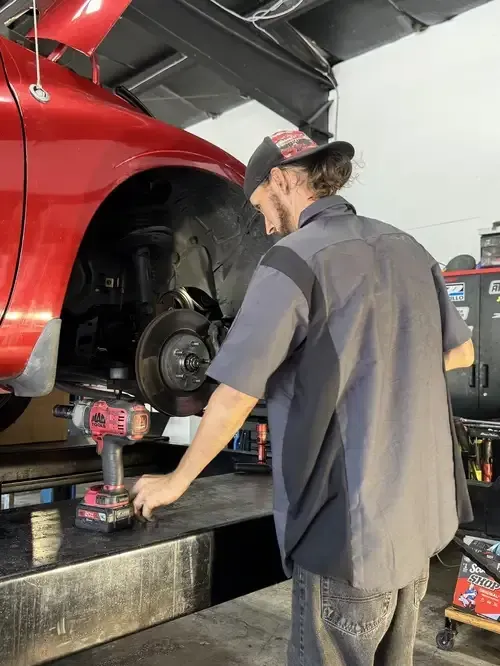
Reliable Tire Rotation in Orange Park
Uneven tread wear across the front axle or a slight steering pull may mean you missed a tire rotation. Tires that wear out at 35,000 miles instead of the expected 55,000 miles can indicate the same problem. Miller’s Automotive performs tire rotations for Ford, Chevrolet, Toyota, Honda, Nissan, Ram, and other domestic and imported vehicles.
We follow the correct front-to-rear or cross-rotation pattern for your vehicle. We also measure tread depth, check the TPMS sensors, and tighten the lug nuts to the manufacturer’s specifications. Our written warranty covers qualifying services. We keep tire rotation affordable and can often combine it with an oil change, saving you an extra trip to the shop.
Drivers commuting between Orange Park, Fleming Island, and Jacksonville on Blanding Boulevard and I-295 put significant load and heat on their front tires. Regular tire rotations help distribute wear more evenly and extend tire life.
Tire Rotation Services at Miller's Automotive
Front-to-Rear Rotation
A front-to-rear rotation moves the front tires straight back and the rear tires straight forward. This pattern is standard for directional tires and vehicles whose manufacturers specify it. On front-wheel-drive vehicles such as the Honda Civic and Toyota Camry, the front tires may wear about twice as fast as the rear tires. They handle steering, braking, and drive torque at the same time.
Before rotating the tires, we measure the tread depth of each one. This allows us to document any differences in wear. We flag tires that fall outside the manufacturer’s tolerance before the uneven wear affects handling.
Cross Rotation Pattern
A cross-rotation pattern moves the rear tires to the opposite front corners and the front tires straight back. We use this pattern for non-directional tires. It helps balance front-to-rear wear and the inner-to-outer wear caused by steering geometry. This is the pattern most sedans and crossovers benefit from, especially vehicles that see a lot of highway miles.
Moving a former front tire to a new position shifts how its tread contacts the road. This helps the tire wear more evenly across the entire contact patch and can extend the life of the set.
Wheel Balancing and Rotation Together
Wheel balancing is a separate service from rotation, but the two are often paired because the weights already need to come off when a tire moves position. If you feel a steering wheel vibration between 55 and 70 mph, a balance is what corrects it, not a rotation.
We recommend a balance every second rotation or any time a vibration is reported. This pairing is also common with a wheel alignment check if the tread is wearing unevenly across the width of the tire rather than front-to-back.
TPMS Sensor Check and Torque Verification
During every tire rotation, we check that each TPMS sensor transmits correctly from its new wheel position. We also inspect the valve stems and wheel-hub mounting surfaces for corrosion or debris. We tighten the lug nuts in a star pattern according to the manufacturer’s specifications. We use a calibrated torque wrench to ensure accurate torque rather than relying on an impact wrench alone.
Correct torque prevents warped rotors on the next hard braking event and keeps the wheel from working loose over the next several thousand miles.
Tire rotation is one part of our broader preventive maintenance services at Miller's Automotive. For related services including oil changes and multi-point inspections, visit our preventive maintenance page.
How to Tell if Your Tire Rotation is Overdue
Uneven Tread Wear Front to Rear
Missing a tire rotation does not create an immediate safety risk. However, significant differences in tread wear can reduce traction on wet roads. Uneven wear may also affect handling during an emergency stop.
Front tires that wear noticeably faster than the rear tires may indicate a missed rotation interval. This often affects front-wheel-drive vehicles used for daily commutes on Blanding Boulevard or US-17. The difference in tread wear can increase with every trip.
Steering Pull or Wander
A vehicle may pull to one side on a flat road or wander within its lane at highway speeds on I-295. Uneven tire wear may cause the problem rather than improper alignment. We confirm this by measuring tread depth at multiple points on each tire before recommending anything beyond a rotation.
Cupping or Scalloped Wear Patterns
Cupping shows up as a scalloped, uneven surface across the tread and produces a rhythmic hum that gets louder with speed. Tires can develop this wear pattern when they remain in one position for too long. Worn shocks or struts can make the problem worse. Once the wear pattern develops, rotating the tires will not correct it.
Vibration Through the Steering Wheel
A steering-wheel vibration that occurs within a specific speed range usually indicates a wheel-balance problem rather than a rotation issue. We can often address both services during the same appointment. Ignoring it wears the inner tie rod ends and wheel bearings faster than they should.
Tread Depth Below the Wear Bar on One Tire
One tire may reach the wear bars while the others still have usable tread. This often means the vehicle went too long without a tire rotation to correct the uneven wear. At that point, we discuss replacement priority honestly rather than pretending a rotation will fix it.
What to Expect During Your Tire Rotation
Intake and Concern Review
We ask about the mileage since the last rotation, any vibrations or pulls you have noticed, and whether the tires have ever been rotated on this vehicle. Your answers help us know what to check when we remove the wheels.
Inspection and Diagnostics
We measure the inner, center, and outer tread of each tire with a depth gauge. We also photograph any unusual wear for your digital inspection report. We check TPMS sensor status, valve stem condition, and sidewall integrity before the rotation begins.
Clear Estimate
We give you a written summary of the tread measurements, recommended rotation pattern, and any related concerns we find. We explain what needs attention now, what may need service soon, and what can wait. We only perform additional work with your approval.
Repair or Service
We move the tires to their new positions using the correct rotation pattern for your vehicle. We then tighten the lug nuts in a star pattern with a calibrated torque wrench, following the manufacturer’s specifications. We relearn TPMS sensors if the vehicle requires it.
Final Review and Follow-Up
We road-test the vehicle at highway speeds to check for vibration, pulling, or unusual noise. You receive documentation of the tread measurements and the recommended interval for your next rotation. This gives you a baseline for tracking tire life across future visits.
Ready to schedule your tire rotation?
What Does Tire Rotation Cost in Orange Park?
Tire rotation at Miller's Automotive is affordably priced and often bundled with an oil change, so you can cover two maintenance items in one visit. The cost varies slightly depending on the wheel type and whether the vehicle needs to relearn the TPMS sensor positions. Pairing the rotation with wheel balancing or a wheel alignment may also affect the price.
We give you a written estimate before starting any work. If we recommend an additional service, we explain why and get your approval first.
Our Promise to You
Every service at Miller’s Automotive begins with a written estimate. Our digital inspections include photos and videos, allowing you to review the tread wear and torque specifications with us. We explain what needs attention now, what may need service soon, and what can wait. If your tires only need a rotation, that is the only service we recommend.
Our written warranty covers qualifying repairs. We also offer early drop-off and after-hours pickup to make scheduling easier. If you need transportation, our partnership with Enterprise Leasing gives you access to discounted loaner vehicles.
What Our Customers Say
Serving Orange Park and Clay County Drivers
Miller's Automotive at 1156 Park Ave serves drivers across Orange Park, Fleming Island, Middleburg, Oakleaf, Lakeside, Green Cove Springs, and Jacksonville. Daily commutes between Clay County and Duval County put more heat and load on the front tires than occasional driving. Regular rotations help all four tires wear at a similar rate. Most tire rotations are completed in about 30 minutes.
Tire Rotation FAQs
How often should I rotate my tires?
You should rotate your tires every 5,000 to 7,000 miles for most vehicles. Pairing the service with an oil change can make the schedule easier to remember. If your owner’s manual specifies a different interval, we follow the manufacturer’s recommendation for your vehicle.
How long does a tire rotation take?
Most tire rotations at our Orange Park shop take about 30 minutes. During the service, we move all four tires to their correct positions and tighten the lug nuts to the manufacturer’s specifications. Pairing it with an oil change is common and adds only a little extra time to the visit.
Do I need a tire rotation and balance at the same time?
No, you do not always need to rotate and balance your tires together. A rotation is usually enough if the vehicle does not vibrate. If the steering wheel shakes between 55 and 70 mph, balancing may correct the problem. We recommend balancing during every second rotation for high-mileage commuter vehicles.
What happens if I never rotate my tires?
If you never rotate your tires, they will wear unevenly and need replacement sooner. On a front-wheel-drive vehicle, the front tires may wear about twice as fast as the rear tires. This creates a cycle of replacing tires at different times. Skipping rotations can also cause cupping, road noise, and reduced traction on wet roads.
What is the difference between wheel rotation and tire rotation?
There is no difference between wheel rotation and tire rotation. Both terms describe moving each wheel and tire assembly to a new position to promote even tread wear. The automotive industry uses the terms interchangeably.
Contact Miller's Automotive for Tire Rotation
Rotating your tires every 5,000 to 7,000 miles helps them wear evenly and last longer. Skipping rotations may cause the front tires to wear out while the rear tires still have usable tread. Call Miller’s Automotive to schedule a tire rotation based on your vehicle and daily driving needs.
