
Discover More On:
Temperature Gauge Rising in Traffic? Here's What It Means for Jacksonville Drivers
Browse by Repair
You're crawling along I-295, and the needle on your temperature gauge starts creeping up. It happens most in heavy traffic, not on the open highway. This pattern alone tells you something specific about what's going on. If you're noticing the temperature gauge rising in traffic more often lately, you're not imagining it. Stop-and-go conditions put a different kind of stress on your cooling system. At Miller's Automotive, we see this exact pattern often once summer traffic picks up.
Why Stop-and-Go Traffic Is Hard on Your Cooling System
Your cooling system depends on airflow moving through the radiator. At highway speeds, that airflow is constant and strong. In traffic, your engine relies almost entirely on the radiator fan instead. A weak, worn, or failing radiator fan can cause the system to fall behind quickly. Overheating often shows up first in traffic rather than on the open road.
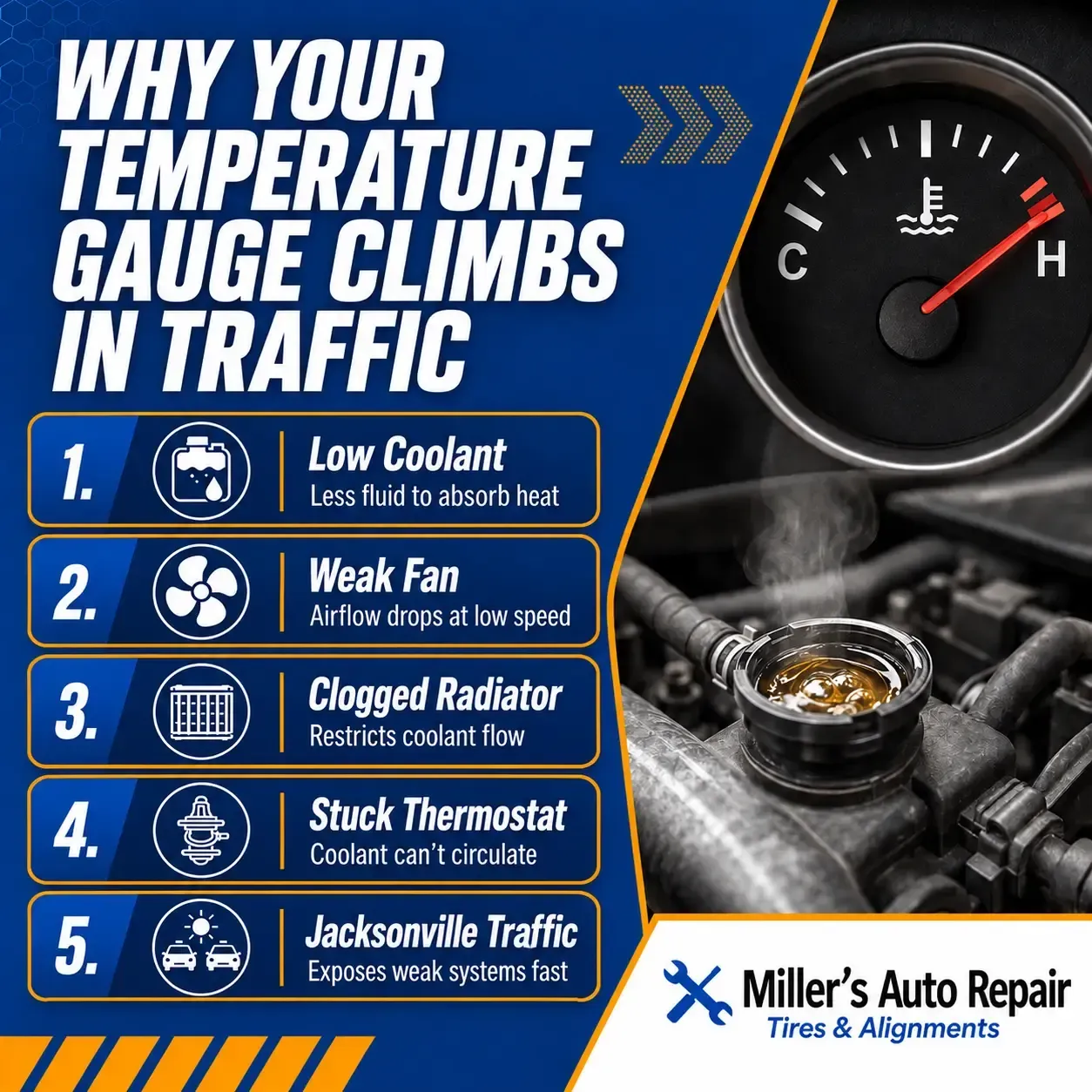
Common Reasons Your Temperature Gauge Rises in Traffic
Several different problems can cause this same pattern. Some are quick, affordable fixes. Others need a closer look before they cause real damage.
Low or Contaminated Coolant
Coolant absorbs and carries heat away from the engine. If the level is low, there's less fluid available to do that job. Old, contaminated coolant also loses some of its heat-transfer ability over time.
A Failing Radiator Fan
The fan pulls air through the radiator when your vehicle isn't moving fast. A failing fan motor or relay means that airflow drops off. Reduced airflow is often the single biggest reason gauges climb specifically in traffic.
A Clogged or Leaking Radiator
Debris, rust, and old coolant can build up inside the radiator over time. This buildup restricts flow and reduces cooling efficiency. A leak has a similar effect since it slowly reduces the coolant available in the system.
A Stuck Thermostat
The thermostat regulates when coolant flows through the radiator. If it's stuck closed, hot coolant can't circulate properly. Engine temperature climbs even though every other part of the system seems fine.
Why Jacksonville Traffic Makes This Worse
Jacksonville's afternoon commute adds real strain on a struggling cooling system. Traffic backs up regularly on I-295 and near the Buckman Bridge during rush hour. Stop-and-go driving is exactly the kind of condition that exposes a weak fan or low coolant.
Summer humidity compounds the problem further. Ambient temperatures in the nineties mean the cooling system starts closer to its limit already. A vehicle that's borderline in cooler months often tips into real overheating once summer traffic arrives.
What to Do If Your Gauge Starts Climbing Right Now
If the needle moves into the red zone, pull over as soon as it's safely possible. Turn off the engine and let it cool before checking anything under the hood. Never remove a radiator cap while the engine is still hot.
Turning the heater on full blast can help pull heat away from the engine temporarily. This won't fix the underlying issue, but it can help you get somewhere safe. Have the vehicle towed or serviced if the gauge climbs again soon after restarting.
How a Mechanic Diagnoses an Overheating Problem
A proper diagnosis starts with checking coolant level and condition. From there, a technician tests the radiator fan, checks for leaks, and verifies the thermostat is opening correctly. This step-by-step process rules out causes instead of guessing at a fix.
Our team frequently checks for signs of a failing radiator as part of that inspection, since it's one of the more common root causes. We document what we find with photos from our digital vehicle inspections, so you can see the exact issue before agreeing to any repair.
Takeaways
A temperature gauge that climbs specifically in traffic almost always points to a cooling system that's already struggling. Common causes include low coolant, a failing radiator fan, a clogged radiator, or a stuck thermostat. Jacksonville's stop-and-go commute and summer humidity tend to expose these weaknesses faster than highway driving would.
Catching the issue early keeps a manageable repair from turning into serious engine damage. A proper diagnosis identifies the real cause instead of guessing at a fix. With clear communication and an honest inspection, Miller's Automotive aims to keep Jacksonville-area drivers cool and confident in traffic.
Frequently Asked Questions About Overheating in Traffic
Is it safe to keep driving if my temperature gauge is rising but not in the red?
Yes, short trips at reduced speed are usually possible if the gauge stays out of the red zone. It's still worth having the system checked soon, since the underlying cause won't fix itself. Waiting too long risks turning a small issue into engine damage.
Can low oil cause my engine to run hotter in traffic?
Yes, low or old oil reduces how well heat moves away from moving engine parts. It's a secondary factor rather than the main cause of most traffic-related overheating. An oil change service is still worth checking alongside the cooling system.
Why does my car only overheat in traffic and not on the highway?
Your car often overheats in traffic because it loses the natural airflow provided by highway speeds. In traffic, your engine relies almost entirely on the radiator fan for that airflow. A weak or failing fan often only becomes obvious in stop-and-go conditions.
How much coolant loss is considered a serious problem?
Any noticeable coolant loss between fill-ups is considered a problem and should be investigated. It usually points to a leak somewhere in the cooling system. Continuing to drive on low coolant increases the risk of engine damage.
What happens if I ignore a rising temperature gauge for too long?
Prolonged overheating can warp cylinder heads, blow gaskets, or damage the engine internally. In severe cases, it can lead to needing an engine replacement rather than a simpler repair. Addressing the gauge early almost always costs less than waiting.
Get Trusted Cooling System Repair Near Orange Park, FL, at Miller's Automotive
A rising temperature gauge in traffic is worth taking seriously before it becomes a bigger problem. Our certified mechanics at Miller's Automotive diagnose the exact cause instead of replacing parts by guesswork. You'll get a clear explanation of what's happening and what it will take to fix it.
If your cooling issue has been building for a while, give us a call at (904) 364-9499 364-9499) or stop by our shop at 1156 Park Ave, Orange Park, FL 32073. We're open Monday through Friday, 7:30 AM to 5:30 PM, and glad to help drivers throughout Jacksonville, Orange Park, and Fleming Island stay cool on the road.

Andrew Harris
Andrew Harris grew up in the bays of Automotive Excellence, the Seal Beach repair shop his father Joe opened back in 1981. When he officially stepped in as owner in 2005, Andrew carried on the family tradition with the same philosophy: deliver reliable auto care built on honesty and craftsmanship. What began as one small shop has grown into two Seal Beach locations, giving local drivers dealership-level service with a family-run feel.
Under Andrew’s leadership, Automotive Excellence has earned AAA Approval and built a team of ASE-Certified and Master technicians. From hybrid diagnostics to precision alignments, auto electrical repairs, and everything in between, his crew uses cutting-edge tools and training to tackle today’s most complex vehicles.
For Andrew, cars are only part of the story. He sees customers, vendors, and employees as neighbors first, and works to make every interaction built on trust and respect. Whether he’s sharing maintenance tips online or talking through a repair at the counter, his goal is to make car care clear, stress-free, and dependable for the Seal Beach community he proudly serves.
Discover More On:
Edward Jay "Ted" Miller
Edward Jay "Ted" Miller is the founder and owner of Miller's Automotive in Orange Park, Florida, where he also serves as shop manager and lead technician. A lifelong Floridian raised in Orange Park, he has spent more than 35 years in the trade.
Ted started at Middleburg High School, completing three years of automotive mechanics training while actively participating in local car and motorcycle events. He came up as a tire and lube technician, then worked at Jim Martin Tires, Saturn of Orange Park, Firestone, and Goodyear, servicing domestic and import vehicles daily. He opened Miller's Automotive in 2008. Now an ASE-certified automotive technician, he still turns wrenches on brake repair and engine diagnostics for Toyota and other domestic and Asian vehicles.
Those years on the floor shaped how he runs the shop. Miller’s Automotive backs every repair with a one-year labor warranty. Ted has followed the same rule since 2008: repair each vehicle as if it belonged to family and recommend only the work it needs. Drivers looking for an auto repair shop in Orange Park, FL, get that same standard.
